Home — Life Sciences and Medicine
Digest note
Jitendra Singh Urges J&K Medicine to Adapt to AI, Genomics and Biotechnology
DateSectionLife Sciences and Medicine
In briefUnion Minister Dr Jitendra Singh said on Saturday that India is on course to lead the next generation of medical practices globally, pointing to rapid advances across life sciences and emerging areas of medical research and technology.
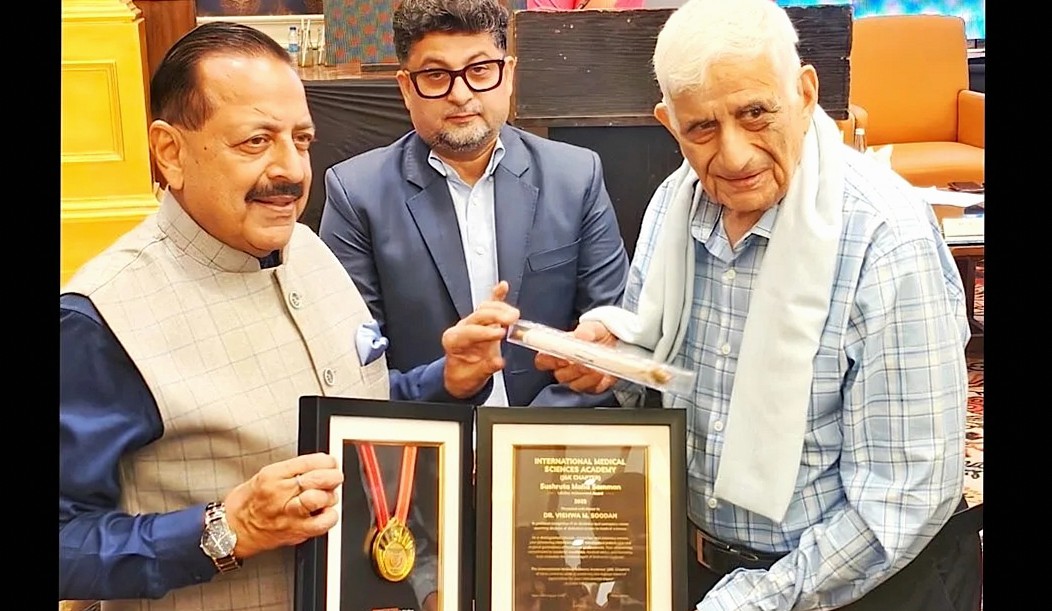
Addressing the 1st Aarogya Shikhar Samman, a medical investiture ceremony organised by the Jammu and Kashmir Chapter of the International Medical Sciences Academy (IMSA) in Jammu, Dr Jitendra Singh described the current moment as an exciting period for medicine. He said emerging technologies are opening new possibilities in healthcare, but that achieving the right balance between technology-driven practice and clinical medicine would be a key challenge.
Dr Jitendra Singh said the future of medical practice would depend on an optimum synergy between those two elements, with artificial intelligence, genomics, quantum technologies and other emerging fields opening new frontiers in healthcare. He also felicitated several senior doctors from the region.
AI as a Tool, Not a Substitute
The minister said AI is proving to be a significant asset in therapeutic and diagnostic procedures. He pointed to its ability to reduce the time needed for cultures and to facilitate gene sequencing, but stressed that technology should not replace clinical medicine. He cautioned that excessive reliance on technology risked undermining the clinical judgement of doctors, and that while technology-enabled options should remain available, sound clinical assessment must stay central to patient care.
Dr Jitendra Singh also warned against injudicious commercialisation in medical practice and the unnecessary prescription of investigations. He said that ordering an avoidable investigation could damage the trust between a doctor and a patient, and underlined the importance of combining technological capability with strong clinical judgement.
India's Expanding Life Sciences Landscape
Highlighting the broader transformation under way in the life sciences, the minister said India is now active across a range of emerging fields, including biotechnology, genomics, precision medicine, vaccines, nuclear medicine, nanomedicine and biomanufacturing. He referred to India's biotechnology policy, Bio E3, which covers biotechnology for environment, economy and employment, and said biotechnology is expected to play a major role in the next industrial revolution.
Dr Jitendra Singh highlighted the expansion of India's bio-economy and the growing support for life-sciences research since Prime Minister Narendra Modi came to office. He mentioned the National Research Foundation and its backing for life-sciences projects, as well as initiatives aimed at encouraging greater private-sector participation in research and development.
On nanomedicine, the minister referred to research into nano-insulin for oral use and work on nano-bots for targeted breast-cancer nanotherapy, citing these as examples of what nanotechnology could offer in medical treatment. He concluded by saying that with the sweeping changes taking place across medical and life sciences, India is moving toward a position where new medical practices can be led by indigenous research, innovation and technology.
Based on reporting by The Statesman
Also in this issue
- India Set to Lead Next Generation of Medical Practices Worldwide, Says MinisterBusiness Standard
- Global Bioinformatics Market Forecast to Hit USD 64.60 Billion by 2034PR Newswire UK
- QuEra Survey: 45% of Firms Now Prioritize Quantum Fault-Tolerance RoadmapsQuantum Zeitgeist
- DOE Report Sets Three-Phase Roadmap Toward Error-Corrected Quantum ComputingQuantum Zeitgeist
- AI Infrastructure Spending Forecast to Hit $769 Billion in 2026 Amid Safety WorriesET Enterprise AI