Home — Space and Earth Science
Digest note
Two New Studies Find Saturn's Moon Enceladus More Hospitable to Life
DateSectionSpace and Earth Science
In briefTwo studies published simultaneously in Science Advances on September 25, 2026 suggest that Saturn's moon Enceladus may be more capable of supporting life, and that any life present there could be more detectable, than scientists previously believed.
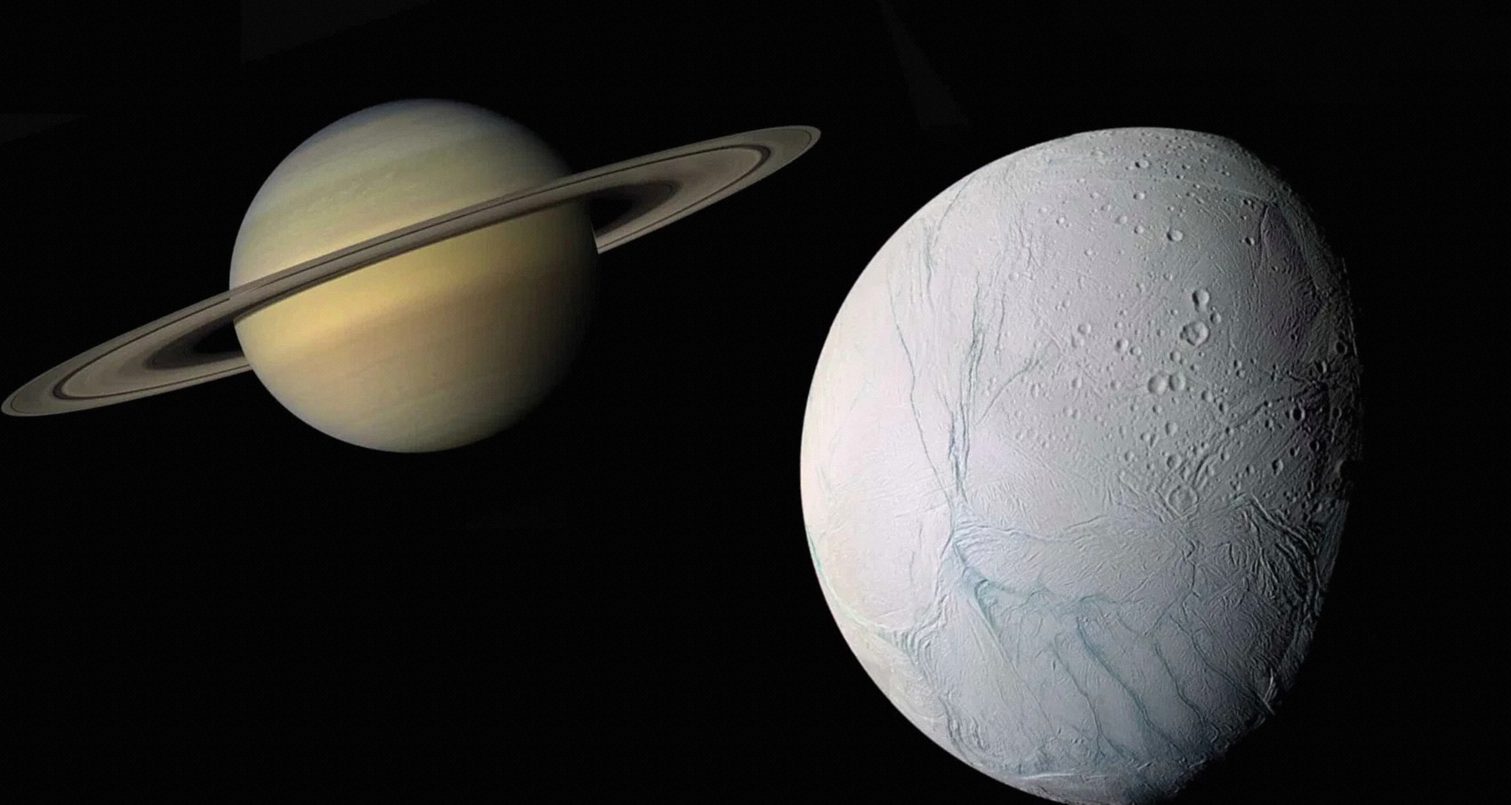
Both papers feature Freie Universität Berlin planetary scientist Professor Frank Postberg and draw on data from NASA's Cassini spacecraft. They add to growing evidence that the first discovery of extraterrestrial life may come not from a distant galaxy but from within our own solar system, where recent Mars findings and speculation about subsurface oceans on several moons have raised that prospect.
An Ocean Beneath the Ice
Unlike Earth, Enceladus is encased in a thick layer of solid ice. Its distance from the Sun means the moon receives relatively little solar heat, keeping its surface far colder than Earth's. Gravitational interactions with Saturn produce tidal forces that generate internal heat, which helps sustain a global ocean beneath the surface. The icy shell reaches roughly 22 miles thick at the equator, though it thins to around 3 miles over the south pole, where cryovolcanic activity forces plumes of water vapor and ice particles through surface fractures and out into space.
Cassini flew through these plumes and collected ice particles for analysis. The material was found to contain salts and organic compounds, along with signs of hydrothermal processes — several of the ingredients and environmental conditions considered important for habitability.
How Ice Grains Form and What They Reveal
The first study combined laboratory experiments and computer simulations to examine how ice grains from Enceladus form and what they can indicate about the moon's ocean. A key finding was that ocean droplets do not freeze instantaneously; instead they freeze gradually, allowing dissolved components to separate across different ice particles. This means substances that appear segregated in individual Cassini samples may in fact coexist within the subsurface ocean.
The researchers also found that biological material, if present, could become concentrated within specific ice grains, potentially making biosignatures easier for future missions to detect. Postberg said that Enceladus "does a lot of the work" in preparing samples in a way that would normally require significant effort in Earth-based chemical laboratories. He described this as "great news in the search for life," adding that future spacecraft analyzing individual plume particles that contain microbial material could identify biosignatures "relatively easily with already available technology."
Microbes in a Simulated Ocean
The second study recreated aspects of Enceladus's ocean chemistry in a laboratory, drawing on ice-sample evidence and observations of the moon. The simulated environment included highly alkaline water, limited carbon dioxide, and chemical influences associated with hydrothermal activity. Into this setting, the researchers introduced Methanothermococcus okinawensis, a methane-producing microorganism found near hydrothermal vents on Earth. It was chosen in part because it does not require oxygen, which is expected to be scarce in Enceladus's ocean.
The microorganism continued to grow under the simulated conditions, producing methane and adjusting its metabolism to function with the restricted amount of carbon dioxide available. Postberg noted that the specific geochemical conditions on Enceladus might allow one of the oldest known metabolic systems on Earth to operate, even in highly alkaline environments. He cautioned that this does not confirm the presence of life on the moon, but said the first study indicates that future space missions "might have a good chance of finding traces if they analyze individual ice grains from Enceladus's plume."
The two papers — "Cassini CDA Observes Compositional Segregation of Enceladus' Ice Grains from Slow Freezing and Fragmentation of Oceanic Spray" and "Enceladus-Like Geochemistry Fuels Methanogenesis Under Extreme CO₂-Limitation" — both appeared in Science Advances on September 25, 2026.
Based on reporting by The Debrief
Also in this issue
- Union Minister Opens World Nanomedicine Congress, Stresses Precision Medicine FutureDaily Excelsior
- Union Minister Urges J&K Institutions to Join India's Healthcare Innovation DriveGreater Kashmir
- QuEra Survey: 45% of Firms Now Prioritize Quantum Fault-Tolerance RoadmapsQuantum Zeitgeist
- DOE Report Sets Three-Phase Roadmap Toward Error-Corrected Quantum ComputingQuantum Zeitgeist
- AI Infrastructure Spending Forecast to Hit $769 Billion in 2026 Amid Safety WorriesET Enterprise AI