Home — Space and Earth Science
Digest note
Union Minister Opens World Nanomedicine Congress, Stresses Precision Medicine Future
DateSectionSpace and Earth Science
In briefUnion Minister of State Dr Jitendra Singh inaugurated the World Congress on Nanomedicine 2026 at Vigyan Bhawan, New Delhi, on 27 September, declaring that nanomedicine will power the next generation of precision and personalised healthcare and that India's home-grown research holds global potential.
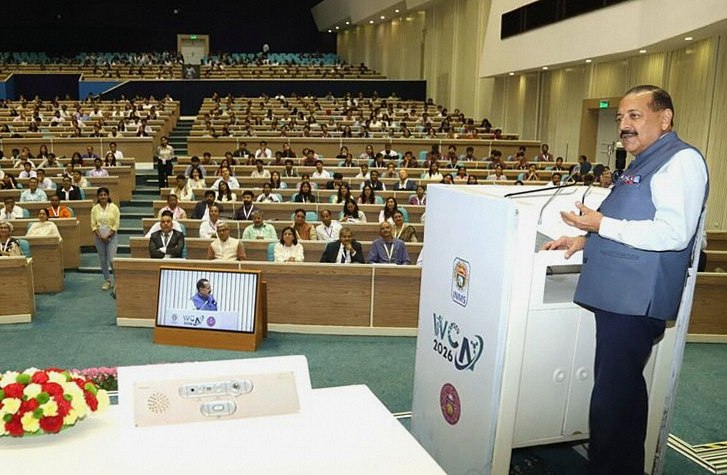
Speaking at the inaugural session, Dr Jitendra Singh described nanomedicine as among the most transformative developments in modern medical practice. He said the field works at the scale of one-billionth of a metre and has the capacity to make healthcare increasingly precise and personalised at the cellular level. He added that the future of medicine would involve individualised treatment shaped by a patient's genetic profile, lifestyle, dietary habits and environmental factors.
The congress, hosted by the Institute of Nano Medical Sciences (INMS), Faculty of Medical Sciences, University of Delhi, has drawn more than 2,000 participants, including senior scientists and early-career researchers, to examine emerging advances and applications in nanomedicine. Nobel Laureate Prof Roger D. Kornberg of Stanford University, USA, is serving as Chairperson, while Prof T.M.S. Chang of McGill University, Canada, is Honorary President. Among those present at the inaugural session were Prof Yogesh Singh, Vice-Chancellor of the University of Delhi; Prof G.P. Talwar; Prof Gobardhan Das, Member, NITI Aayog; Prof Ramesh Chandra; and Prof Indrajit Roy.
The Minister said nanomedicine's significance extends beyond direct patient care, with its applications expected to affect the cost-effectiveness of health processes and contribute more broadly to the economy. He cited growing global interest in the field as a measure of the scale of opportunity it represents.
Technology Must Support, Not Replace, Clinical Judgment
Dr Jitendra Singh cautioned against over-reliance on technology in medical practice. While tools such as artificial intelligence and nanotechnology are opening new possibilities, he said they must complement rather than undermine the clinical judgment of doctors. The core challenge, he argued, is to bring advanced technology into alignment with the human and clinical dimensions of medicine. He also called for medical education to be reimagined in light of rapid technological change, stressing that foundational skills in observation and physical examination should remain central even as digital and scientific tools grow more sophisticated.
Government Backs 210 Nanomedicine Research Projects
Detailing government support for the sector, the Minister said the Department of Biotechnology is funding 210 R&D projects in nanomedicine at a total cost of ₹174 crore. The projects span targeted drug delivery, cancer nanomedicine, infectious-disease nanomedicine, nucleic-acid and vaccine delivery, nano-diagnostics and imaging, regenerative medicine and wound healing, and nanotoxicology and regulatory science.
Among specific research areas highlighted were oral insulin nanoparticles, nanobots for breast cancer, precision nanoinjection and targeted breast cancer nanomedicine. Dr Jitendra Singh noted that earlier work on oral insulin had encountered challenges related to absorption and digestive enzymes, and said advances in nanotechnology could open new avenues to address these difficulties.
The Minister said India's nanomedicine ecosystem is growing beyond laboratory settings, with government backing extending to start-ups, infrastructure, technology development and regulatory facilitation. Through BIRAC, emerging biotechnology enterprises can access support via programmes including the Biotechnology Ignition Grant (BIG), Promoting Academic Research Conversion to Enterprise (PACE), Small Business Innovation Research Initiative (SBIRI) and the Biotechnology Industry Partnership Programme (BIPP). India has also established a regulatory framework for nanopharmaceuticals through guidelines developed jointly by DBT, ICMR and CDSCO, covering the safety, quality and efficacy of nanopharmaceutical products.
Prof Roger D. Kornberg described nanomedicine as a young and rapidly evolving discipline with considerable potential for the future of healthcare. He said it offers the prospect of precision — delivering the right amount of treatment to the right location at the right time — while improving effectiveness and reducing toxicity, with uses across drug delivery, diagnosis, imaging and regenerative medicine.
The World Congress on Nanomedicine 2026 is being organised under the umbrella of the International Society of Nano Medical Sciences (ISNS) and the International Society for Nano Medicine (ISNM), providing a platform for scientists, researchers, students and industry professionals to share knowledge, form collaborations and engage with the latest developments in the field.
Based on reporting by Daily Excelsior
Also in this issue
- Union Minister Urges J&K Institutions to Join India's Healthcare Innovation DriveGreater Kashmir
- Two New Studies Find Saturn's Moon Enceladus More Hospitable to LifeThe Debrief
- QuEra Survey: 45% of Firms Now Prioritize Quantum Fault-Tolerance RoadmapsQuantum Zeitgeist
- DOE Report Sets Three-Phase Roadmap Toward Error-Corrected Quantum ComputingQuantum Zeitgeist
- AI Infrastructure Spending Forecast to Hit $769 Billion in 2026 Amid Safety WorriesET Enterprise AI