Home — Space and Earth Science
Digest note
Union Minister Urges J&K Institutions to Join India's Healthcare Innovation Drive
DateSectionSpace and Earth Science
In briefUnion Minister of State Dr Jitendra Singh on Saturday called on Jammu and Kashmir to actively engage with emerging fields such as clinical medicine, biotechnology and technology-driven healthcare, speaking at the 1st Aarogya Shikhar Samman ceremony in Jammu.
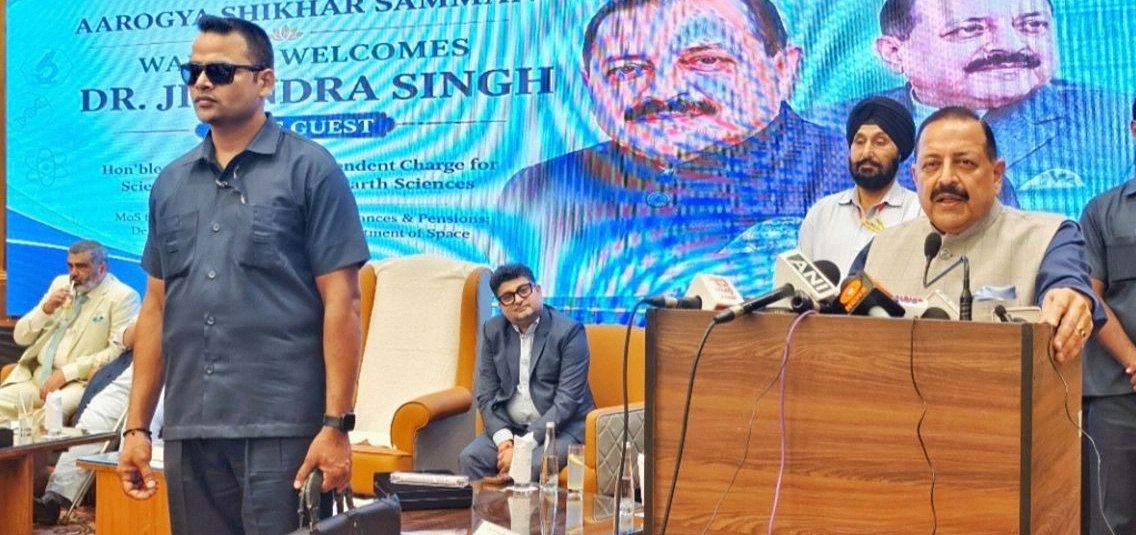
Dr Jitendra Singh, Union Minister of State in the Prime Minister's Office, addressed the inaugural Aarogya Shikhar Samman — a medical investiture ceremony organised by the Jammu and Kashmir Chapter of the International Medical Sciences Academy (IMSA) in Jammu on Saturday. He called for a change in mindset and a reorientation of approaches to medicine so that Jammu and Kashmir could participate more actively in emerging areas of healthcare.
The minister described the current moment as an exciting period for medicine, saying India is positioned to lead the next generation of medical practices globally, with rapid advances being made across life sciences and medical technology. He said emerging technologies are opening new possibilities in healthcare, but that achieving an optimal balance between technology-driven practices and clinical medicine would be the central challenge ahead.
Dr Jitendra said Artificial Intelligence is proving to be a significant asset in therapeutic and diagnostic procedures, including by reducing the time needed for cultures and enabling gene sequencing. He cautioned, however, that technology must not become a substitute for clinical medicine, warning that excessive dependence on technology risks undermining a doctor's clinical judgement. He stressed that while technology-enabled options must remain accessible, clinical assessment should stay at the core of patient care.
He also cautioned against injudicious commercialisation in medical practice and unnecessary prescription of investigations, saying that ordering an avoidable investigation could erode trust between a doctor and a patient. He recalled the traditional emphasis in medicine on spending adequate time with patients, taking their history and correlating diagnostic findings with clinical observations.
India's Advances in Life Sciences
Outlining the broader transformation in life sciences, Dr Jitendra said India is now active across biotechnology, genomics, precision medicine, vaccines, nuclear medicine, nanomedicine and biomanufacturing. He referred to India's biotechnology policy, Bio E3 — covering biotechnology for environment, economy and employment — and said biotechnology is expected to play a major role in the next industrial revolution.
On vaccines and preventive healthcare, he noted that India developed a DNA vaccine for COVID-19 that was gifted to 30 countries. He also spoke about two indigenous antibiotics developed in India, with the active pharmaceutical ingredient produced domestically and trials conducted at an institute in Faridabad. Regarding genomics, he referred to the India Genome Sequence initiative and cited a successful trial in treating haemophilia through a genetic approach, with research published in the New England Journal of Medicine.
Dr Jitendra highlighted developments in nuclear medicine, referring to a successful trial in acute lymphoblastic leukaemia at the Tata Institute in Mumbai. On nanomedicine, he mentioned research into nano-insulin for oral use and work on nano-bots for targeted breast-cancer nanotherapy. He also highlighted Sri Chitra Institute in Trivandrum, which he said has moved beyond treatment and medical education into manufacturing export-quality medical devices at lower cost.
Funding and Opportunities for J&K Institutions
The minister referred to the National Research Foundation and its support for life-sciences projects, as well as a Rs 1 lakh crore research, development and innovation fund, with contributions split equally between the private sector and the government, aimed at encouraging greater private-sector participation in research and innovation.
Dr Jitendra urged government and non-government institutions in Jammu and Kashmir to become partners in these emerging areas of medical research and innovation. He said financial, technical and infrastructure support — including laboratories and facilities — is available, and encouraged institutions in the region to submit proposals. He called on the medical and scientific community of J&K to be more forthcoming so that opportunities could be pursued on the basis of merit.
Felicitations at the Ceremony
Among those honoured at the ceremony were Dr Ravinder Madan, former Head of Department of Gynaecology; Dr V M Sudan; Dr Yudhvir Gupta, former HoD Pathology; Dr Yudveer Gupta, former HoD Pathology, GMC Jammu; Dr C L Gupta, former HoD Urology; Dr Rajender Singh, former Principal of GMC Jammu; Dr Bella Mahaja, former HoD Microbiology; Dr R P Kudyar, former HoD Medicine and Endocrinology; and Dr Pawan Malhotra, Director ASOCHAM, among others.
Congratulating the organisers, Dr Jitendra said the ceremony provided an opportunity to acknowledge medical professionals who have spent a lifetime building their reputation and serving patients. He also acknowledged the demanding workload of practising clinicians, whose responsibilities tend to grow with seniority, and extended appreciation to the spouses of practising doctors for managing family and social obligations alongside their partners' demanding professional schedules.
Based on reporting by Greater Kashmir
Also in this issue
- Union Minister Opens World Nanomedicine Congress, Stresses Precision Medicine FutureDaily Excelsior
- Two New Studies Find Saturn's Moon Enceladus More Hospitable to LifeThe Debrief
- QuEra Survey: 45% of Firms Now Prioritize Quantum Fault-Tolerance RoadmapsQuantum Zeitgeist
- DOE Report Sets Three-Phase Roadmap Toward Error-Corrected Quantum ComputingQuantum Zeitgeist
- AI Infrastructure Spending Forecast to Hit $769 Billion in 2026 Amid Safety WorriesET Enterprise AI